 Sacred Sexuality in Ancient Egypt: The Erotic Secrets of the Forbidden Papyri, Ruth Schumann Antelme & Stephane Rossini
Inner Traditions, 0892818638, 1999, 32 pp. (incl. appendices, notes, glossary, bibliography, and index)
Ruth Schumann Antelme is an Egyptologist, a former professor at the Ecole de Louvre, and an emeritus researcher of the CNRS in France (National Center for Scientific Research). The illustrator, Stephane Rossini, has illustrated other books on the subject of Egyptology. Some of the illustrations have been “restored,” based on other samples.
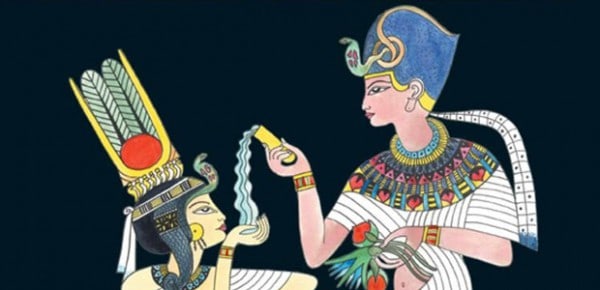
Some of the images contained within this volume (there are more than 150 black-and-white illustrations and 20 colour plates) are the ones familiar to the reader on the subject of Egyptian religion. The majority of them, however, are definitely not of the G-rated variety. For those who are used to thinking of the life of Egypt in the sanitized form we learned about in school, there are shocks in store.
As should be obvious to anyone who stops to think about it, a region such as Egypt (which is obviously dependent upon a fertility religion because of the climate) must have included images of fertility and procreation among its religious artwork.
The notes refer to some extremely specialized publications that may be unfamiliar to most readers (as they were to me). This, however, only serves to expand the field of exploration for those interested in continuing their education on this topic.
The author doesn’t hesitate to note where uncertainty exists in regard to the meaning of a given drawing, carving, or other illustration. Where uncertainty exists about the actual content or form of a given illustration, she points it out in Sacred Sexuality in Ancient Egypt.
The appendices include an extremely simplified chronology of ancient Egypt from the Early Dynastic period (circa 300 BCE) to the Byzantine domination (circa 400 CE); a list of the deities mentioned in the current work; Egyptian place names; some hieroglyphic examples; and a glossary.